
Story, Transmedia and Game Design: Inside the Develop:Brighton Storytelling Panel
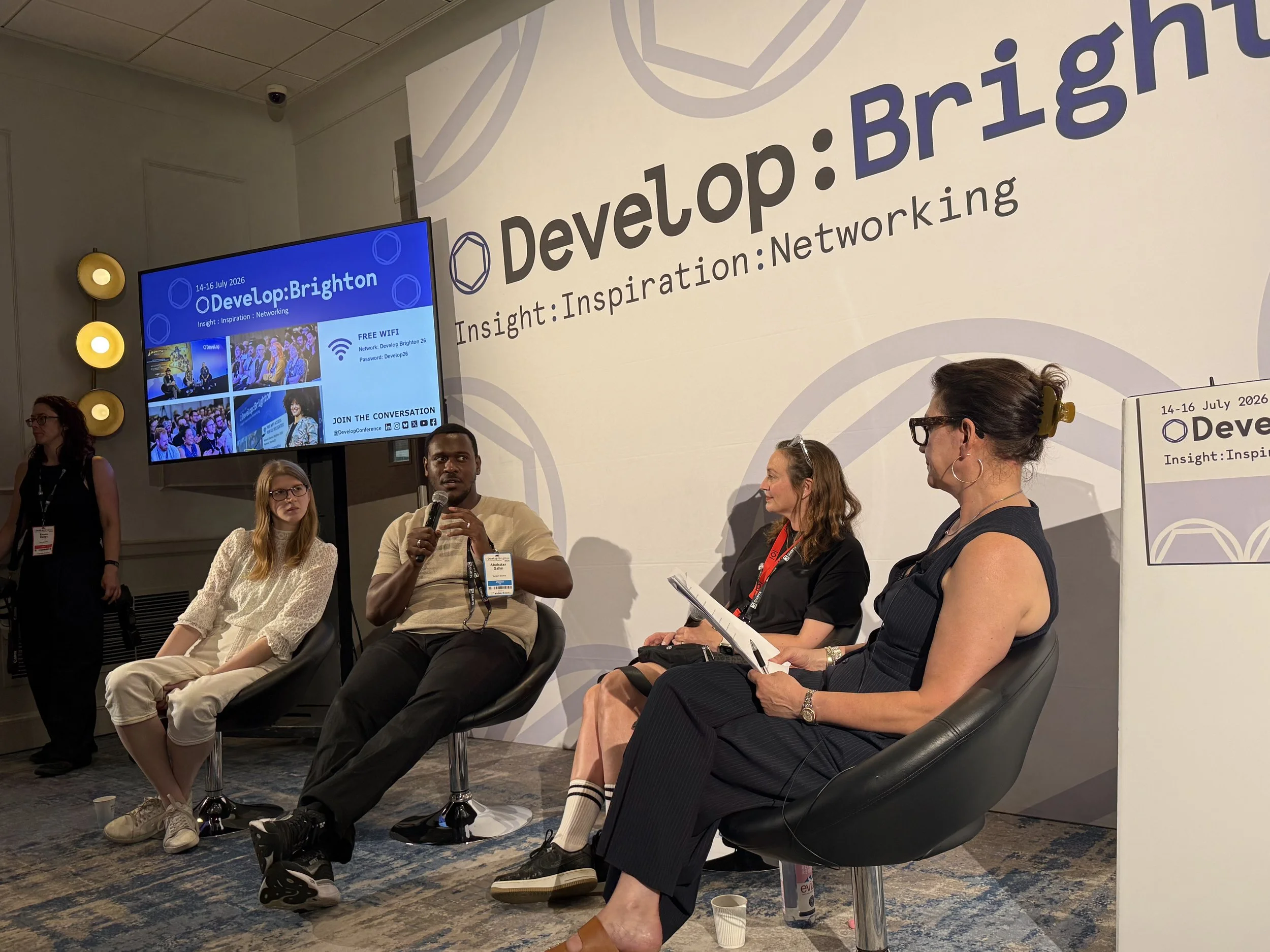
Develop:Brighton Storytelling Panel - from left to right Eloise Singer, Abubakar Salim and Veronique Lailler and Panel Host Jane Millichip from BAFTA
Does The Medium Define the Story
At a packed panel during Develop:Brighton, a room of developers, writers, and players gathered to discuss a question that has loomed over the industry for decades: Does the medium define the message, or does the story itself transcend the technology? To unpack this, three BAFTA-affiliated creatives took to the stage to share their experiences navigating the increasingly fluid boundaries between games, television, and film hosted by Jane Millchip from BAFTA.
The Powerhouse Panel
The stage was shared by three developers who refuse to be boxed into a single medium.
Veronique Lallier, the Chief Development Officer at IO Interactive, brought over two decades of global executive experience from giants like Rockstar, NCSoft, and Warner Bros.
Sitting alongside her was Abubakar Salim, the founder and Creative Director of Surgent Studios, a BAFTA-nominated actor (Raised by Wolves, Assassin's Creed Origins), and the visionary behind the BAFTA-winning platformer Tales of Kenzera: Zau.
Completing the lineup was Eloise Singer, the Emmy-nominated writer, director, and CEO of Singer Studios, whose interactive VR project The Pirate Queen (starring Lucy Liu) recently made waves at the Cannes Film Festival.
Finding the Human Truth: Why "Story is King"
Opening the panel, the classic Marshall McLuhan adage was thrown to the floor: Is the medium the message? For Abubakar Salim, the answer is a definitive no. Technology and platforms will always shift, but the core of what makes us care about a story remains entirely unchanged.
"For me, it's story." Salim explained. "As long as the story is truthful and honest, and connects to us on a level that speaks beyond sex, race, or gender—to that thing that makes us human—that is what powers my vision. The medium has to serve the story you're trying to tell, rather than trying to shoehorn a story into a medium."
Salim pointed to Tales of Kenzera: Zau as the perfect example. While the game is wrapped in vibrant Bantu mythology and fast-paced metroidvania mechanics, the emotional anchor of the project is entirely universal: grief. "At its core, it's about a young man figuring out life after his father has passed away," Salim said. "The African mythology is there because that's what I know, but the human truth is what actually resonates with players."
The Transmedia Trap: "If You're Telling the Same Story, You're Doing It Wrong"
With adaptations like The Last of Us, Fallout, and Arcane dominating global screens, "transmedia" is the buzzword of the moment. However, Eloise Singer warned that simply copying and pasting a narrative across different formats is a recipe for failure. She shared the best piece of advice she ever received on the subject:
“If you are trying to tell the exact same story in two different mediums, you are doing it wrong.”
According to Singer, creators must keep the characters and the world intact, but completely change how they tell the story to suit the format.
In traditional film and television, the viewer is passive. The storyteller holds the camera, controlling exactly what the audience sees and framing precise, specific emotions. Video games, on the other hand, demand active participation. By giving the player agency, games force them to embody the weight of a character's choices, building a deeper, more sustained empathy.
Meanwhile, mediums like graphic novels offer a vastly different canvas, allowing creators to explore a character’s entire lifetime in rich detail rather than compressing it into a single night of survival.
Reshaping the Narrative and Challenging Cultural Snobbery
The panel also addressed the lingering cultural snobbery that often places literature and cinema on a higher intellectual pedestal than video games.
Veronique Lallier, shared a personal perspective on how interactive worlds can act as a crucial gateway to culture. Growing up, traditional books were incredibly difficult for her to engage with. Instead, she found solace, imagination, and intellectual stimulation inside game worlds. Lallier argued that active participation in a virtual space is just as intellectually demanding as reading, requiring players to interpret environments, make split-second decisions, and actively co-author their own experiences.
Singer went a step further, suggesting that the traditional entertainment industry's skepticism toward gaming might actually be rooted in a bit of professional jealousy.
"I think the film and TV industry are really pissed off that games can actually command so much audience attention," Singer joked. "They would like that, and they can't achieve it. We have a responsibility as a collective to remind people that this is an incredibly important medium for sharing knowledge, creating empathy, and stepping into other worlds."
The Cold, Hard Business of Pitching: Games vs. TV
When discussing whether the business models of these industries are actually ready to support early-stage, cross-medium collaboration, the panel pointed to a stark divide in funding and creative development.
Salim, who successfully pitched and secured a publishing deal with EA Originals for his debut game, noted that the games industry can sometimes be paradoxically more open to bold, untried concepts—even if the financial stakes are brutally high.
In film and TV, development is often a softer, more collaborative process. A studio might give a writer a small sum of development money to explore an idea, accepting the risk that it might lead to nothing.
In gaming, however, Salim found that publishers expect creators to have the project almost entirely figured out before they write a check. It is an all-or-nothing gamble where developers are forced to bank heavily on themselves before anyone else will take a chance on them.
Reaching for Optimism in Tough Times
As the session drew to a close, the panel and the audience acknowledged the tough economic headwinds currently facing the film, television, and gaming sectors alike. Layoffs, studio closures, and cautious funding have left many in the industry feeling understandably anxious about the future.
Yet, when asked who in the room still felt optimistic about the future of storytelling, nearly every hand shot into the air.
While the business models, consoles, and technologies of the next 50 years are impossible to predict, the human urge to share experiences will always remain the industry's ultimate anchor. Long after players forget the specific graphics, the frame rates, or the console generations, the stories they lived through will be the things they carry with them.
