
Making Lego Batman: Legacy of the Dark Knight Funny and Fun - TT Games Developer Deep Dive
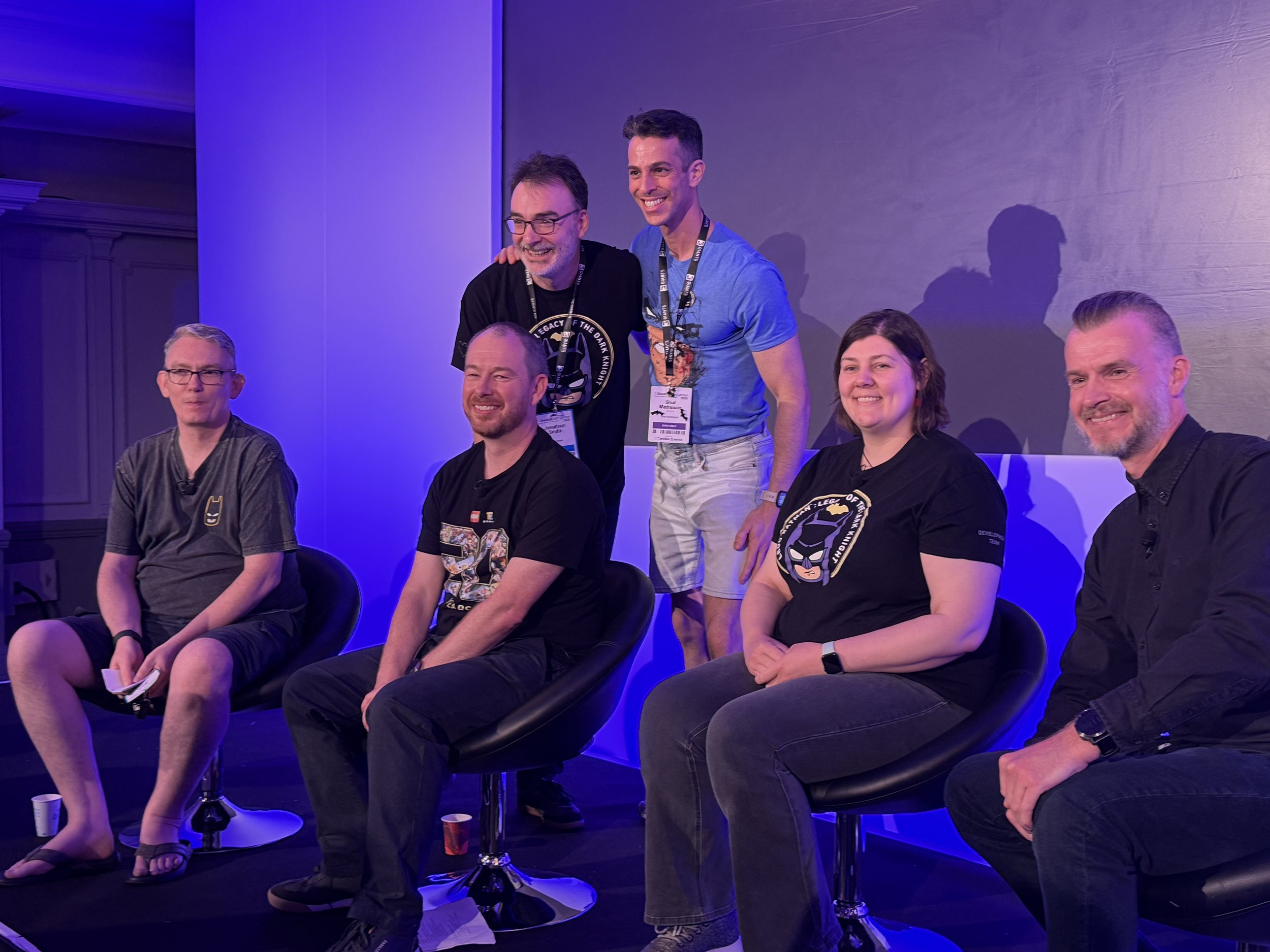
TT Games Panelist & Batman Voice Actor - from left to right front row Mark Green, Rian Walters, Ruthie Nielson, Dave Woodman. Back row left to right Jonathon Smith and Shai Matheson
Brick, Combat, and Duck Boats: Inside Lego Batman: Legacy of the Dark Knight
The energy inside the main auditorium at Develop:Brighton was absolutely electric as the creative leads from TT Games took the stage. They were there to deliver a comprehensive, behind-the-scenes breakdown of Lego Batman: Legacy of the Dark Knight—a title that has officially broken records as the highest-rated Lego game in history.
To explain how they pulled off this monumental feat, Game Director Mark Green, Game Programming Director Rian Walters, Director of Technical Animation Ruthie Nielsen, Project Art Director Dave Woodman, and Head of Production Jonathon Smith pulled back the curtain on their development journey.
80 Years of History, One Single Timeline
Following the massive success of Lego Star Wars: The Skywalker Saga, the team at TT Games refused to play it safe. They completely abandoned their internal tech stack to rebuild their entire workflow from scratch in Unreal Engine 5.
To tackle 80 years of disparate comic book, animated, and cinematic lore, Game Director Mark Green threw traditional continuity out the window. The team designed a custom timeline based on chronological narrative flow rather than real-world release dates. The campaign seamlessly careens from the gritty realism of Batman Begins straight into the rain-slicked modern noir of The Batman, before swinging back to the gothic atmosphere of Tim Burton’s Batman ’89. Once this multi-generational narrative architecture was locked down, the team applied their golden rule: they started packing it with jokes.
"Arkham, But Funny" Combat and the Cape Crisis
The developers explicitly targeted an older, core gaming audience by reimagining the combat loop as a streamlined, highly accessible take on Rocksteady’s Arkham series. Internally, the mandate was simple: "Arkham, but funny."
Programming Director Rian Walters explained that Unreal Engine 5’s Motion Warping plugin became their secret weapon, allowing Batman to fluidly glide and drive from one enemy to another. To keep the action fresh across roughly 100 hand-animated combat variations, Walters' team engineered a backend tech system that ensures players see every single visual variation before a combat animation ever repeats.
This relentless focus on fluidity placed massive pressure on the animation department. Because TT Games entirely rejects motion capture in favor of hand-keyed animation, every punch and cape swish had to be built from scratch. Director of Technical Animation Ruthie Nielsen highlighted the intense physics battles they fought during pre-production.
"Early on, we had a glitch we called the 'Bat-Bib,'" Nielsen explained. "Whenever Batman moved too fast, the cape would whip violently and get permanently stuck over Batman’s face, like a bib. We had to assemble an emergency, cross-discipline 'Cape Team' just to iterate on the simulation until it could flawlessly survive high-speed vehicle boosts."
The Wedding Cake Architecture of Gotham City
Art Director Dave Woodman oversaw a team of 100 artists tasked with building a living, breathing open world teeming with traffic, pedestrians, and environmental storytelling.
The aesthetic foundation of the city relies on an architectural concept the team dubbed "The Wedding Cake." Because Gotham has zero actual city planning, modern infrastructure is built directly on top of historical layers. Street-level players can look up from a classic, Burton-inspired gothic stone foundation to see bright, 90s Joel Schumacher neon overlays, all crowned by the sleek, oppressive structures of modern cinema.
To make the city feel truly multi-generational, the developers engineered Gotham to dynamically morph across three distinct chronological eras as the campaign progresses. Walk down an alley in the first era and you'll spot a vintage vinyl shop. Return later, and it has upgraded into a 90s CD storefront while the local civilians swap their dark coats for neon shell suits. In the final era, the store has evolved into a modern mobile phone shop or a closed-down property up for lease.
The commitment to immersion even extended to the audio department. The team secured access to a secure movie prop archive in the UK, where they uncovered real live-action movie vehicles. They fired up the engines of the actual Batmobile used in the films recording authentic exhaust roars to build the game's high-octane vehicle soundscapes.
The Defeated Mini-figure Dilemma
The team heavily relied on constant user testing to refine their mechanics, which occasionally led to sudden, drastic design pivots. Mark Green shared a fascinating hurdle regarding Batman's strict "no-kill" rule. In early builds, the team left defeated enemies scattered across the pavement to mimic the Arkham games.
Playtesters ran into roadblocks: when a Lego mini figure lies completely motionless on the ground, it doesn't look knocked out—it looks explicitly dead. The team tried adding classic comic book dizziness birds spinning above their heads, but it only led to mechanical confusion. Trusting the data, the developers immediately scrapped the system and returned to the classic, universally satisfying Lego tradition of having defeated thugs completely explode into loose bricks.
A Surprise Voice from the Shadows
During the middle of the presentation, the team blindsided the audience with an unforgettable moment. Sitting quietly in the crowd was Shai Matheson, the voice behind the Caped Crusader himself. Shai joined the panelist on stage with his iconic, gravelly Dark Knight register. When asked about his experience crafting a voice that honours Batman’s legacy without being a cheap imitation, Matheson shared his absolute favourite line from the entire game.
"It’s somewhere in the Penguin's lair," Matheson laughed. "A duck boat explodes, and I just yell, 'Duck boat! No!' It is so stupid and makes zero sense, but it’s easily my favourite line."
It is exactly that mix of cinematic reverence and self-aware absurdity that proves TT Games didn’t just build another licensed title—they delivered a brilliant, boundary-pushing love letter to the entire history of the Dark Knight.
